

Best Gold Jewelry Brands 2026: A Buyer's Guide
Last Updated: October 24, 2026
Quick Summary
The best gold jewelry brands in 2026 are the ones that disclose karat, construction, hallmarking, repair terms, and honest pricing on every listing. Solid 14K or 18K gold is the safer choice for pieces worn three or more times a week, while plated gold jewelry suits trend-led pieces you rotate occasionally. If a brand is vague about the base metal or how its gold jewelry is built, it is not the best, no matter how good the photos look.
- Solid gold is one alloy throughout and can usually be repolished or resized; plated pieces generally cannot be repaired once the coating wears.
- 14K yellow gold is roughly 58.3% pure gold, while 18K is about 75% pure gold.
- Match construction to wear pattern: lean solid for pieces worn three or more times a week, plating for seasonal experiments.
- Check that the karat stamp on the piece or clasp matches the listing, alongside a maker's mark.
- Build a collection in three layers: everyday pieces first, then bridal and occasion, then statement pieces.
Table of Contents
- Why the Best Gold Jewelry Brands 2026 Demand a Closer Look
- Solid Gold Jewelry Brands vs. Gold-Plated: What Lasts
- Gold-Plated vs. Solid Gold Jewelry: Construction, Care, and Cost
- Gold Jewelry Trends 2026: Bold Gold and Minimalist Design
- How to Find the Best Online Gold Jewelry Stores
- Purity, Hallmarking, and Authenticity Checks Before You Buy
- Building a Timeless Collection: Everyday, Bridal, and Statement Pieces
- Frequently Asked Questions
Why the Best Gold Jewelry Brands 2026 Demand a Closer Look
The global jewelry market is projected to reach $254.13 billion in 2026 and climb to $387.36 billion by 2034, a 5.41% compound annual growth rate, according to Fortune Business Insights' jewelry market forecast. That growth hides a problem: the label "gold" now covers everything from 18-karat solid pieces to a whisper of gold-tone plating over brass.
At Valentine Rouge, we build our collection around a simple belief: a piece should outlive the trend that inspired it. That's why this guide focuses on what actually separates a lasting piece from a disposable one.
Below, we break down karat, construction, care, and the buying signals that matter, so you can spend once and wear for years.
Solid Gold Jewelry Brands vs. Gold-Plated: What Lasts
Solid gold jewelry is made entirely of a gold alloy, while gold-plated jewelry is a base metal coated with a thin layer of gold. That difference decides how long a piece survives daily wear.
Solid gold jewelry brands work in alloys such as 14-karat or 18-karat gold, which mix pure gold with other metals for strength. The piece holds its color through years of wear and can usually be repolished or resized.
Plated pieces rely on a coating measured in microns, and that coating wears thin at the points of friction: clasps, ring bands, the back of an earring.
- Solid gold: same metal throughout, repairable, higher upfront cost
- Gold vermeil: a thicker gold layer over sterling silver, a middle ground
- Gold-plated: a thin gold layer over brass or steel, the most budget-friendly
- Gold-tone: a color finish, not a precious metal content at all
If you want a piece you can wear daily for a decade, solid gold is the safer bet.
Gold-Plated vs. Solid Gold Jewelry: Construction, Care, and Cost
The gold-plated vs. solid gold jewelry decision comes down to three trade-offs: how the piece is built, how you care for it, and what it costs over its lifetime.
Construction. Solid gold is one alloy throughout, so there is no layer to wear through. Plated jewelry depends on the thickness and quality of its coating, and that layer is what eventually fails.
Care. Solid gold tolerates daily wear, perfume, and hand-washing with occasional cleaning. Plated pieces need gentler handling: keep them away from moisture and harsh chemicals, and store them dry.
Cost. Plated jewelry costs less at purchase but often needs replacing. Solid gold costs more upfront and holds value longer, which is why cost-per-wear is the fairer comparison.
| Factor | Solid Gold | Gold-Plated |
|---|---|---|
| Construction | One alloy throughout | Thin gold layer over base metal |
| Lifespan with daily wear | Years to decades | Months to a few years |
| Care needs | Low; occasional polish | High; keep dry and separate |
| Repair potential | Can be resized and repolished | Limited once plating wears |
| Best for | Everyday and bridal pieces | Trend-led statement pieces |
Gold Jewelry Trends 2026: Bold Gold and Minimalist Design
Gold jewelry trends in 2026 split into two clear lanes: bold gold pieces and modern minimalist designs, according to Gabriel & Co.'s 2026 trend guide. The interesting part is that both are selling to the same buyer, and the smartest buyers are matching the trend to the right gold construction.
Bold gold means sculptural cuffs, chunky chains, and layered necklaces that read as statement pieces from across a room.
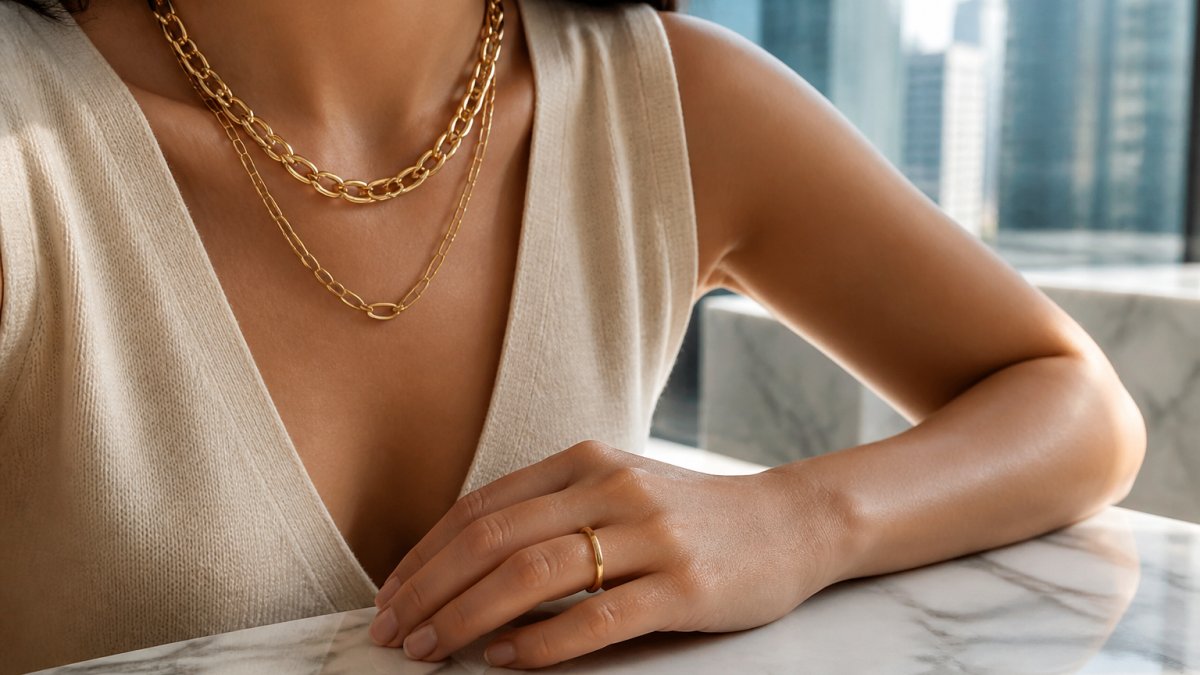
Designers are also pulling from the past. Vogue's 2026 jewelry brand roundup notes that several designers look to antiquity and vintage inspiration, which fits the Neo-Baroque mood we design around at Valentine Rouge: ornate references, cleaned up for modern wear.
But here is the gold-specific angle most trend reports skip: the construction that makes a trend piece last depends on the trend itself.
A simple rule: match the construction to the wear pattern, not just the look. If you expect to wear a piece three or more times a week, lean solid.
The practical takeaway: buy one bold anchor piece in solid gold and build minimalist everyday jewelry around it, choosing solid gold or vermeil for the pieces you never take off. That combination covers occasion wear and the office without a full overhaul, and without replacing your favorite chain every year.
How to Find the Best Online Gold Jewelry Stores
The best online gold jewelry stores share four traits: they state the metal content plainly, show real product photography, publish a clear return policy, and stand behind their craftsmanship. If a storefront hides any of those, keep scrolling. But for gold specifically, the vetting goes deeper than generic e-commerce checks, and most roundups stop short of telling you what to verify.
Start with the product page. It should name the karat (14K, 18K, 24K), the base metal if the piece is plated or vermeil, and whether the piece is solid, vermeil, or plated.
Next, check the return window and the repair policy together.
Then look for proof of authenticity and accountability. In the United States, the FTC's jewelry guides set the rules for how gold content must be described, including karat markings.
Finally, compare price transparency. A brand that publishes representative price ranges by karat and construction, rather than hiding every price behind a "contact us" form, makes it easier to judge cost-per-wear.
- Metal content and karat stated on every listing
- Base metal and plating thickness disclosed for vermeil and plated pieces
- Close-up photography, including clasps, settings, and hallmarks
- A written return, exchange, and repair policy
- Reputable press coverage or third-party features
- Clear care instructions and warranty terms
Purity, Hallmarking, and Authenticity Checks Before You Buy
Hallmarking is an official stamp that confirms a piece's metal purity, applied by an assay office. It is your clearest protection against mislabeled gold.
In the United States, the FTC's jewelry guides set the rules for how gold content must be described, including karat markings. In the UK and parts of Europe, hallmarking is a legal requirement for precious metal pieces above certain weights.
What to check before you buy:
- The karat stamp. 14K, 18K, or 24K should appear on the piece or clasp, matching the listing.
- The maker's mark. A brand identifier alongside the purity stamp.
- The metal description. "Solid gold," "gold vermeil," and "gold-plated" are not interchangeable.
- The certification. For gemstones, ask whether the stones are lab-grown or natural, and get it in writing.
For recycled and lab-grown materials, Forbes' reporting on affordable jewelry notes that brands use recycled metals and lab-grown stones to lower costs without sacrificing quality. Ask any brand how they verify those claims, and expect a straight answer.
Building a Timeless Collection: Everyday, Bridal, and Statement Pieces
A timeless collection is built in three layers: everyday jewelry you never take off, bridal and occasion pieces with sentimental weight, and statement pieces that carry an outfit.
Everyday pieces should be solid gold or high-quality vermeil, simple enough to wear with everything: a fine chain, small hoops, a signet ring.
Bridal jewelry rewards a slower purchase. Look for craftsmanship you can inspect, settings that hold stones securely, and a design that won't date. Bridal elegance should still feel like you in ten years.
Statement pieces are where you can have fun with bold gold, sculptural shapes, and intricate designs. Buy one or two you genuinely love rather than five you tolerate.
At Valentine Rouge, our approach is exactly this: timeless jewelry with a modern twist, designed to layer across all three categories. Our pieces have been featured in InStyle, Elle, and US Weekly, and spotted on Reese Witherspoon and Jennifer Aniston, which tells you the aesthetic travels from red carpet to real life.
Frequently Asked Questions
What are the best jewelry brands in gold for 2026?
The best gold jewelry brands 2026 balance material transparency, craftsmanship, and price. Look for brands that state karat and construction clearly, such as 14k or 18k solid gold versus gold vermeil or plating. Valentine Rouge offers luxury fashion jewelry with a timeless, modern twist and complimentary North American shipping on orders $150 and up.
Is solid gold better than gold-plated jewelry?
Solid gold is an alloy of gold and other metals throughout the piece, so it resists tarnish and can be repaired and resized. Gold-plated and vermeil pieces carry a thin gold layer over a base metal, which means the finish can wear with daily use. Solid gold costs more upfront but offers better durability and long-term value. Gold-plated pieces suit occasional wear and trend-led styles. Choose based on how often you plan to wear the piece and your budget.
How can you tell if gold jewelry is good quality?
Check the hallmark or stamp inside the piece for the karat, such as 14k or 18k, and the maker's mark. Ask the retailer for the construction method: solid gold, gold vermeil, or gold-plated. Solid gold should feel dense and carry consistent color throughout. For online purchases, review the return policy and any third-party verification of ethical sourcing. Reputable stores state material and karat openly on each product page rather than in fine print.
What karat gold is best for everyday jewelry?
14k gold is the practical choice for everyday wear. It contains 58.5% gold mixed with alloys that add strength, so it holds up to daily use better than softer 18k or 22k gold. 18k gold, at 75% gold, offers richer color and suits occasional or statement pieces. For rings and bracelets that take frequent contact, 14k reduces scratching and denting. If you prefer a deeper yellow tone and gentler wear, 18k works well for necklaces and earrings.
The hardest part of buying gold jewelry is trusting a screen instead of a jeweler's loupe. Valentine Rouge was built for that gap: a curated collection of luxury fashion jewellery with a modern, feminine edge, complimentary shipping within North America on orders of $150 and up, and no tariffs for USA customers. Start with one piece you'll wear this week, and build from there.
